

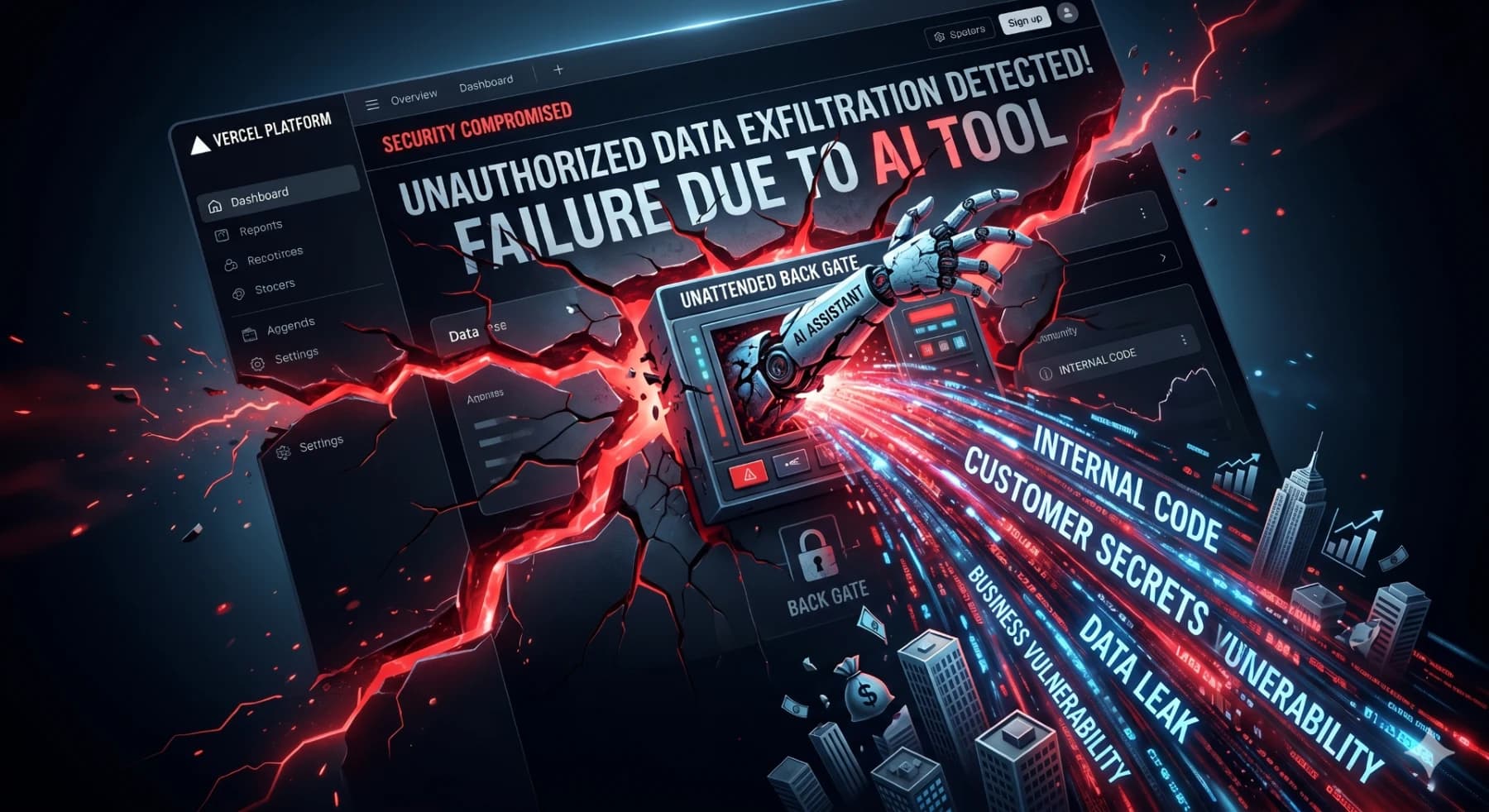
For months, the tech industry has been obsessing over AI — racing to integrate AI coding assistants, productivity agents, and automated workflows to boost developer speed. But this blind rush has a catastrophic blind spot. The recent April 2026 Vercel security breach has brutally exposed how these "smart" tools can become fatal vulnerabilities.
Today, businesses are eagerly granting third-party AI platforms sweeping access to their internal environments. While the promise is hyper-productivity in programming, the reality is far more dangerous: unattended backdoors, bypassed security protocols, and massive corporate data leaks. So, is AI the ultimate developer tool? Not quite — it is rapidly becoming the ultimate security threat. Here is why the recent Vercel breach proves that unchecked AI integration is a fatal flaw for businesses
The Trojan Horse: How an AI Tool Hacked Vercel
Unlike traditional brute-force attacks, the Vercel data breach didn't happen because a master hacker broke through a rigid firewall. It happened because of a trusted AI tool. A Vercel employee integrated a third-party AI platform called Context.ai into their workflow, granting it broad "Allow All" OAuth permissions to their corporate Google Workspace.
When the AI tool was compromised, the attackers inherited those exact permissions. They bypassed multi-factor authentication (MFA) completely and waltzed right into Vercel’s internal systems. The result? A threat actor known as "ShinyHunters" allegedly listed Vercel's internal data, source code, and customer environment variables for sale on the dark web for $2 million. The very AI meant to assist the ecosystem became the unattended back gate that let the attackers in.
The Fatal Flaw of AI "Convenience"
In the old security model, businesses fought to lock down every endpoint. Now, companies are willingly handing over the keys to AI platforms in the name of speed. The focus has shifted from "security first" to "AI-accelerated deployment." But as Vercel CEO Guillermo Rauch noted, the attackers themselves likely used AI to move with surprising velocity and a deep understanding of the compromised systems once inside. AI didn't just provide the backdoor; it armed the intruders.
Relying on AI integrations creates massive vulnerabilities for businesses:
✔ Blind Trust in Third Parties: Granting AI tools broad access to emails, codebases, and corporate drives.
✔ Bypassing Core Security: OAuth tokens given to AI often bypass traditional MFA protections entirely.
✔ Unattended Back Gates: Developers forget about the AI plugins they authorized, leaving persistent, unmonitored entry points.
✔ Exposed Secrets: Attackers can easily scrape non-sensitive environment variables that developers accidentally loaded with API keys, GitHub tokens, or database credentials.
The more you rely on interconnected AI tools to write code and manage workflows, the wider your attack surface becomes.
The Illusion of AI Productivity
AI programming assistants and workspace agents are sold as the future of tech, but they are introducing unprecedented supply chain risks into the enterprise software lifecycle. Today, protecting your business means recognizing that AI is a double-edged sword:
- Permissions Overreach: AI tools inherently demand massive amounts of context and data to function, requiring dangerous levels of access.
- Speed Over Safety: AI accelerates the development pipeline, but it also accelerates the speed at which a breach spreads across your network.
- Third-Party Compromise: Your security is only as strong as the weakest AI startup your employees are using.
- Data Leaks: Feeding proprietary code or enterprise data into external AI models strips away your control over where that data ends up.
Brands that blindly adopt every new AI coding assistant will inevitably fall victim to the very tools they thought were keeping them competitive.
Why Securing Against AI is Essential Now
Treating AI as an infallible assistant is no longer an option — it’s a fatal business risk. If you aren’t actively monitoring and restricting what AI tools can access in your ecosystem, you will lose your data to competitors or cybercriminals.
To survive the AI-driven threat landscape, businesses must pivot by:
Conducting ruthless security audits of all third-party AI apps and OAuth permissions
Enforcing Zero Trust architectures that do not give AI tools "Allow All" access
Ensuring strict secret management, keeping API keys out of environments that AI agents can read
Revoking idle AI integrations that act as unattended backdoors into your corporate identity suites
Implementing anomaly detection to catch high-velocity, AI-driven attacker movements
Future-Proof Your Business Against AI Vulnerabilities
The Vercel incident is a loud wake-up call: unchecked AI integration is a massive, fatal failure point. By prioritizing security over the illusion of AI-driven convenience, you ensure that your proprietary code, customer data, and brand reputation remain safe.
Don't let a "smart" AI programming tool be the reason your company makes headline news for a catastrophic data breach. It's time to close the back doors.
Explore our services: Web Development · Shopfiy Development
✨ Ready to audit your digital infrastructure and secure your web presence against AI supply chain attacks?
Let’s secure your business today →